


Review - Castlevania: Belmont's Curse Is A Brilliant Revival

Thank you for checking out Bonfire Sit. If you haven't already, subscribe to my YouTube channel, the Bonfire Sit Podcast, and follow me on Instagram for more #content from me.

Castlevania: Belmont's Curse is all about legacy. Rose Belmont fights to prove she's worthy of inheriting her family's Dracula-hunting duty. Konami returns to a crowded genre to show that the franchise that defined it, still has a place within it. Developers Evil Empire and Motion Twin strive to show they can rise to the challenge and restore Castlevania to glory. In each case, the stakes are high and the odds feel impossible.
I can't say whether Rose lives up to the Belmont legacy, but it's undeniable that Konami, Evil Empire, and Motion Twin live up to Castlevania's. Belmont's Curse is spectacular. It stands shoulder-to-shoulder with the best games in the genre it created and, more importantly, the best the series has to offer.
Very few games generally have the gothic horror vibe that Castlevania has made its signature. And while previous entries in the 2D series leaned more into the gothic part of the pairing, with intricate aristocratic costuming, elaborate mediaeval castles, and the whole pipe organ played in an empty cathedral flavor of unnerving, Belmont's Curse goes the other way by placing more of an emphasis on the horror element.
It all begins on the streets of Paris, where Rose arrives to find the city besieged by whatever evil is emerging. The aesthetic makes a strong impression from the very outset, with a blood moon hanging over the city, bathing it in a blanket of malevolent energy. Fires rage, buildings are crumbling, and the skeletal remains of the people mark just how dire the situation is. The streets of Paris are just one of the many incredibly striking and memorable environments that players will move around in Belmont's Revenge.
Between the city and Dracula's castle, each area has its own unique aesthetic and visual footprint. From the blood red streets, there's the swampish green of the sewer area, the molten orange of the dedicated to constructing Dracula's castle, and many more. Each location is detailed in eye-catching ways such that it feels like the castle has existed for a millennia; in some areas its through features such as towering statues and grand staircases that illustrate the scale of the castle. In others, it's paintings that call back to characters from games and stories of the past.
Belmont's Curse modernizes the way Castlevania looks with clean and colorful art style that evokes the Netflix series, but without undermining the identity of the series. Its developers use its color palette beautifully to make everything vibrant and saturated, but at the same time still feel ominous and gothic. Different color pallets are layered on top of each other to not only present a rich contrast, but when combined with a parallax scrolling effect, to create a sense of depth to the world. Whether you're in the depths of the catacombs or the heights of the clocktower, there's an ever-present sense that the evil you're fighting has reached out beyond the castle you're in to take hold of the world around you.
I also really love how the game relishes in rewarding those with history with the series through its details. Belmont's Curse often feels like connective tissue between different eras of Castlevania, so it's not uncommon to walk into a room and spot something that either overtly references people or evokes a place from the wider series.
That sense of depth also extends into the way the castle is laid out. Snaking corridors made up of long hallways, floors to drop through, alcoves to slide into, and hidden rooms to discover are nothing new to Castlevania. But there's more of an emphasis in creating rooms within rooms, either serving as their own cordoned off spaces or as pathways to other parts of the castle. Fast-travel isn't as prominent a mechanic as it has been in previous games, but there are doors all over the place that will get you from around and between sections of Dracula's domicile. It's a really smart way of ensuring navigation isn't laborious while also accentuating the feeling of being in a labyrinthine place.
Without any sort of objective marker or go-here hint, getting turned around and lost is a common occurrence. In games like this the feeling of being lost and then discovering a new path way forward is a fundamental part of the experience, but to my mind, it's a carefully orchestrated process where designers plot where you need to go, where you'll find yourself in a dead end, and what you'll probably do next. There's as much an illusion of freedom as there is actual freedom.

In Belmont's Curse, that illusion still exists, but at the same time the game is more open-ended than any other entry in the series. Rose's goal is to find key members of Dracula's supernatural cadre, but the order with which you do so is less restrained. Instead, you encounter clues about them and where they may be; a ghost reciting a poem of how they were ensnared by one fiend; notes detailing what another monster has been doing that point to where they may be hiding; environmental puzzles that, over the course of many hours, will slowly form a breadcrumb trail.
Each boss is represented by an arcana in a deck of tarot cards that is given to Rose at the start of the game. Clues are logged in each of the cards to refer back to so, as you piece things together, a complete picture of the target comes into view. This system is really clever because it not only makes discovery feel more non-linear, but also allows a story to be told about each character while also making the player feel like a genuine vampire hunter doing detective work. Some of these characters are not easy to find, so it can be that you discovered the arcana card for one but don't finally find them until close to the end of the game.
The tarot deck becomes how Rose's progress is tracked, but also how her abilities as a vampire hunter develop. Some characters, when defeated, are captured in a card, at which point they become a companion for the remainder of the game. Each of them have their own distinct personalities, histories, and motivations. They talk to Rose and to each other, so the player is essentially gathering a cast of backseat drivers; some who want her to succeed, others who want her to fail. This is a change from previous games, where isolation is important or, at most, characters will check in with each other at important junctures or, in the case of Portrait of Ruin, have a pair of characters to swap between.
It's a change I appreciated since it gives more body to the story in a series that otherwise is content with laying out a core premise and then detailing the rest of the story with broad strokes. The personality each character injects into the game reminded me of Supergiant's Hades games, where beautiful character portraits would pop up in key moments with a few lines of dialogue to keep the journey engaging.
Outside of conversations, the cards and the entities within them also bestow new abilities on Rose. Although they are mostly stand-ins for sub-weapons or combat abilities in previous games–like throwing a cross or petrifying enemies–they often come with abilities that unlock new traversal options and open up the castle further. Each ability card also features a set of objectives for the specific skill that, when completed, will allow Rose to modify or enhance how it functions. The majority of Curse of Belmont's mechanics are represented by the tarot deck, but it's done in such a way that it never feels overwhelming. Instead, everything you have, need to know, and could get are gathered in a unified system that feels elegant and rewarding to engage with.
That uniformity also applies to weapons, which are less plentiful in Belmont's Curse, but still offer plenty of variety. Instead of having dozens of weapons, Rose can select from a handful of weapon classes, be it whip, sword, greatsword, gauntlets, or anything else. Within those classes, there are different versions of the same weapon that can be found. They all function the same, with a primary attack, an air attack, and often a secondary attack. The dual swords, for example, are quick and deadly, but have a secondary attack that chains together multiple flurries provided the attack button is hit within a very specific timing window. The heavy sword has a charged attack that does much more damage; the lance can be thrown from a distance, and so on. The only real differentiator between them is the attack power, which slowly escalates with each one you find, though it's definitely possible to find them out of order or miss some entirely.
They largely look the same, but each one has a number of different animations that show off how cool they are but also how capable Rose is with them. With the whip, for example, Rose twirls around in different ways; or with the gauntlet she strikes different fighting poses–and some of them are references to other games and characters. So even without looking different, they still have a lot of personality to them.
The last piece of the Castlevania puzzle is the traversal and additional abilities that you may find along the way. Fundamentally, the way Rose moves feels great from the outside, there's a good heft to her movement but she also feels quick on her feet. Then, as you unlock further options, getting around becomes quicker and more satisfying, since there's an element of skill added. The heavy lifting is done by the whip, which can be used to latch onto grapple points to swing around, but also launch yourself at enemies, during which each weapon has its own mid-air special attack that's different from the one Rose does simply by jumping with her legs.
At various points other options will open up which I won't spoil, but I will call out that one of them unlocks a parry ability, since it's a major part of the combat. Enemies in the game are very aggressive and, between the ones that fly at you, launch projectiles, attack up close, or are lumbering power houses, there's usually a barrage of attacks coming Rose's way at all times. The parry is mapped to its own button, and you are required to use it often in tandem with your own attacks and maneuvering. The game can be tricky at times, either because of enemy placement, difficult combat rooms, or just hard bosses, so the parry is essential. Regardless of how difficult it becomes though, the combat is always satisfying. And if you find yourself struggling, you can use the assists tucked away in the settings to give yourself more of an edge, though it is noted that this could mess with the balance.
The joy of playing Belmont's Curse isn't in experiencing something revolutionary or revelatory–there's nothing like that. Instead, it's in seeing how elegantly it's design ideas are connected, how thoughtfully its world is constructed, how lavish it looks, sounds, and feels, and how masterfully it's all brought together into one outstanding package. Good Metroidvanias aren't a rarity anymore. But Belmont's Curse is a reminder that, when Castlevania is done right, there's nothing else quite like it.
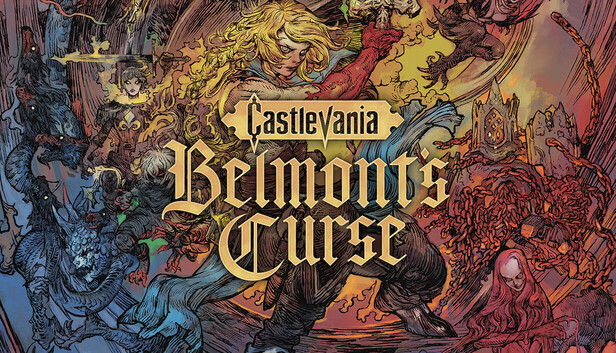
Crimson Curse —Will Your Fate Bloom in Despair or Salvation Set 23 years after Castlevania Dracula's Curse - follow a young Belmont's journey in an all new 2D Action-Exploration title from KONAMI, Evil Empire and Motion Twin.